
Steadi-3 Plus
Stabilise Your Hands. Reclaim Your Freedom.
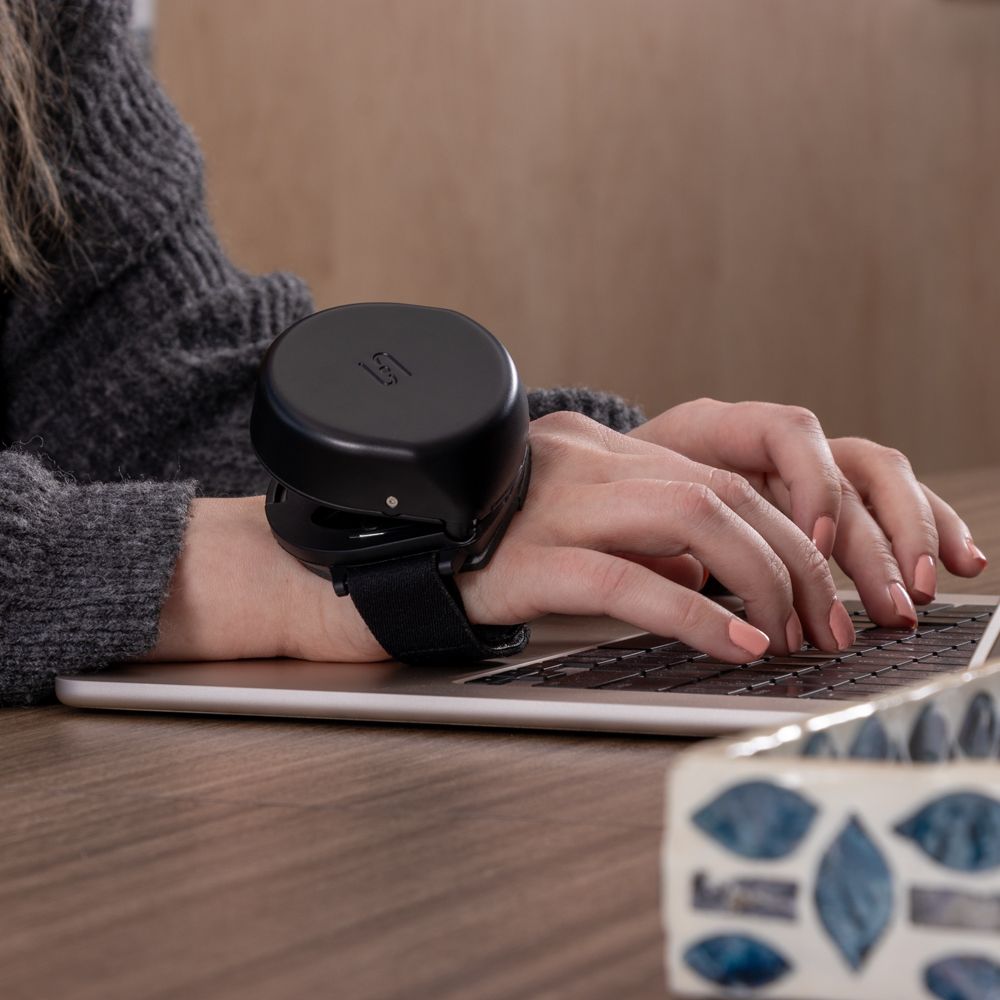
The Steadi-3 Plus is a battery-free anti tremor glove using passive magnetic stabilisation to counteract tremor without charging, electronics, or setup. It is designed for Essential Tremor and the action-tremor component of Parkinson’s Disease. As a wearable tremor device, it has been clinically evaluated: 84% of users in a placebo-controlled study showed improved tremor control versus no device, and 70% showed improvement over a placebo hand tremor glove based on blinded neurologist assessments.1,2 It is a TGA listed medical device, available without a prescription.9
Overview
What is Steadi-3 Plus?
Not all gloves for tremors use the same mechanism. The Steadi-3 Plus is a purpose-built essential tremor glove: instead of relying on weight alone, it uses passive magnetic stabilisation to counteract tremor motion, with no batteries and no charging. A healthcare provider can help determine whether it is appropriate.
Battery-Free
Effective
Ultra-lightweight design
How it works
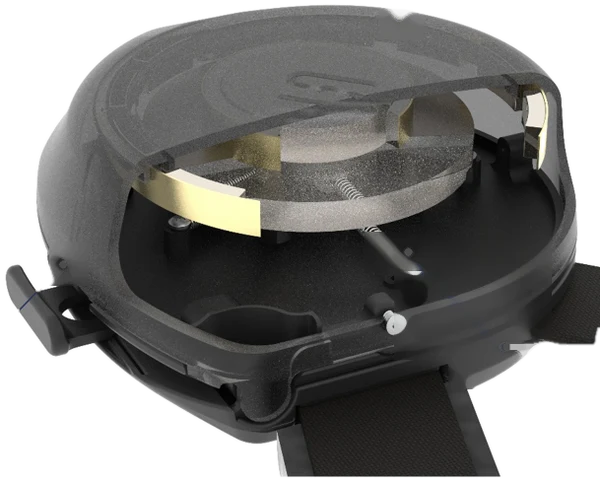
Steadi-3 PlusTechnology Explained
Borrowed from earthquake engineering
A tall building is steadied by a tuned mass damper: a heavy mass that moves out of step with the building and absorbs its sway. A building sways at one frequency, so one spring is enough. Tremor moves: it changes between people, and within one person with fatigue, medication and the task.
Lab test, November 2025: on an instrumented test rig, the device absorbed 2 to 3 times more vibration than the same weight added passively, and added no new frequencies.4 A test rig is not a hand, so this shows how the mechanism works, not how much a person’s tremor will drop.
Clinical Evidence
Neurologist-rated tremor reduction across everyday tasks
8 in 10
vs no device
Participants with a lower (better) tremor severity rating from a blinded neurologist when wearing the device than when wearing nothing. Blinded study, 9 adults with Essential Tremor.2,6
7 in 10
vs weighted placebo
Compared with a placebo device of identical look and weight, worn by the same participants. This controls for the effect of added weight and expectation.2
43%
lower severity vs no device
Average fall in clinician-rated tremor severity across three tasks. Against the weighted placebo, the average fall was 29%.2
83%
after one week at home
Participants in a separate one-week follow-up (12 people) who reported significant improvement, with no adverse events. Self-reported, with no comparison group.1
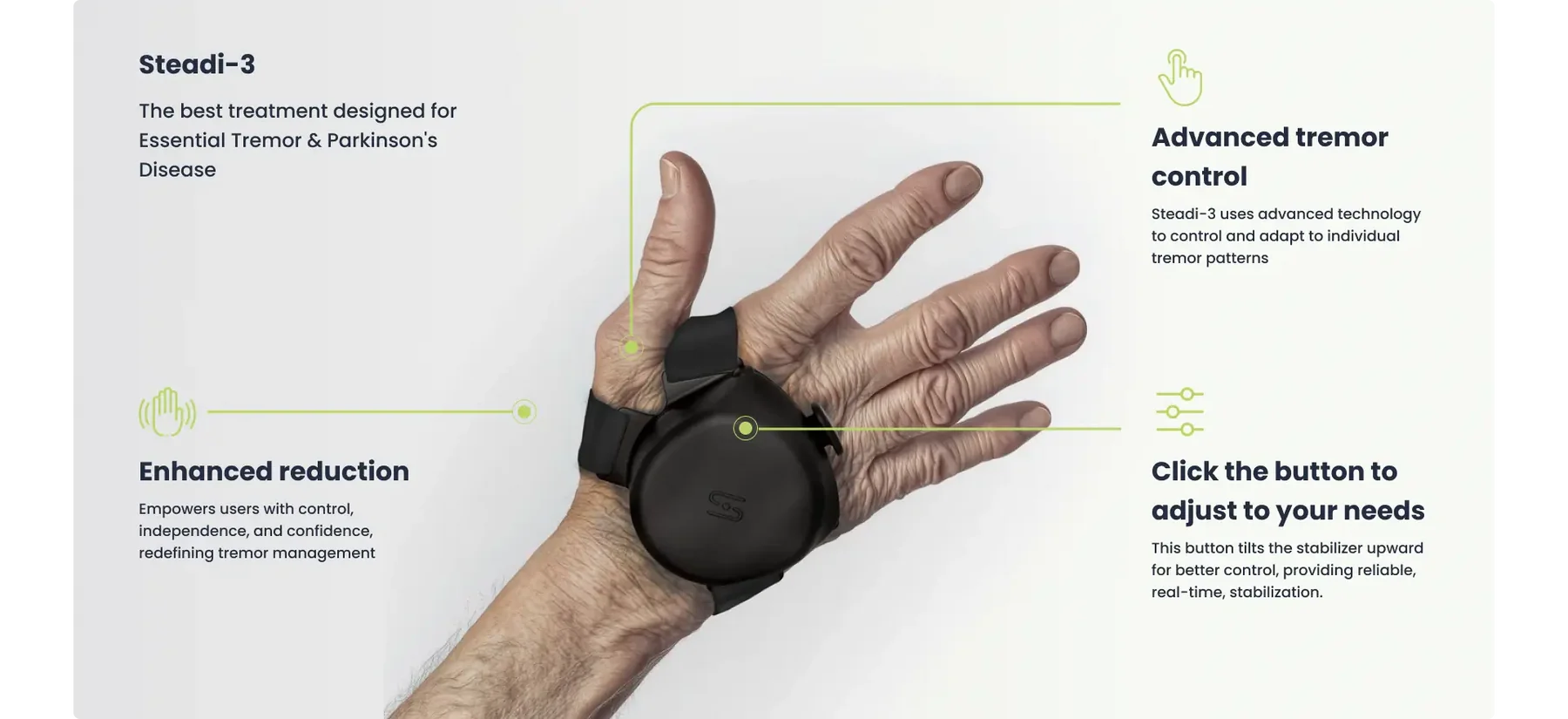
The same spiral, minutes apart
Nine adults with Essential Tremor did three tasks (drinking from a cup, finger to nose, and drawing an Archimedes spiral) under three conditions, in random order:
- No device.
- A weighted placebo device of identical appearance, with no active mechanism.
- The Steadi-3.Blinding
Recordings were masked, then scored blind by a neurologist on a modified Fahn-Tolosa-Marín scale. The scorer did not know which condition they were watching.
Funding
The study was designed, run and funded by Steadiwear Inc. (internal report, February 2025, available on request). Read the results with that in mind.2
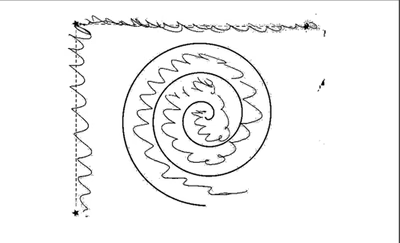
Without the device
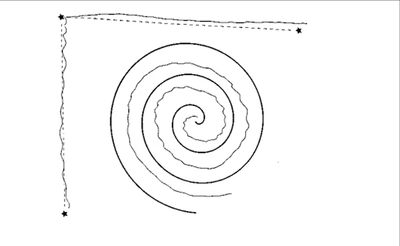
With the Steadi-3
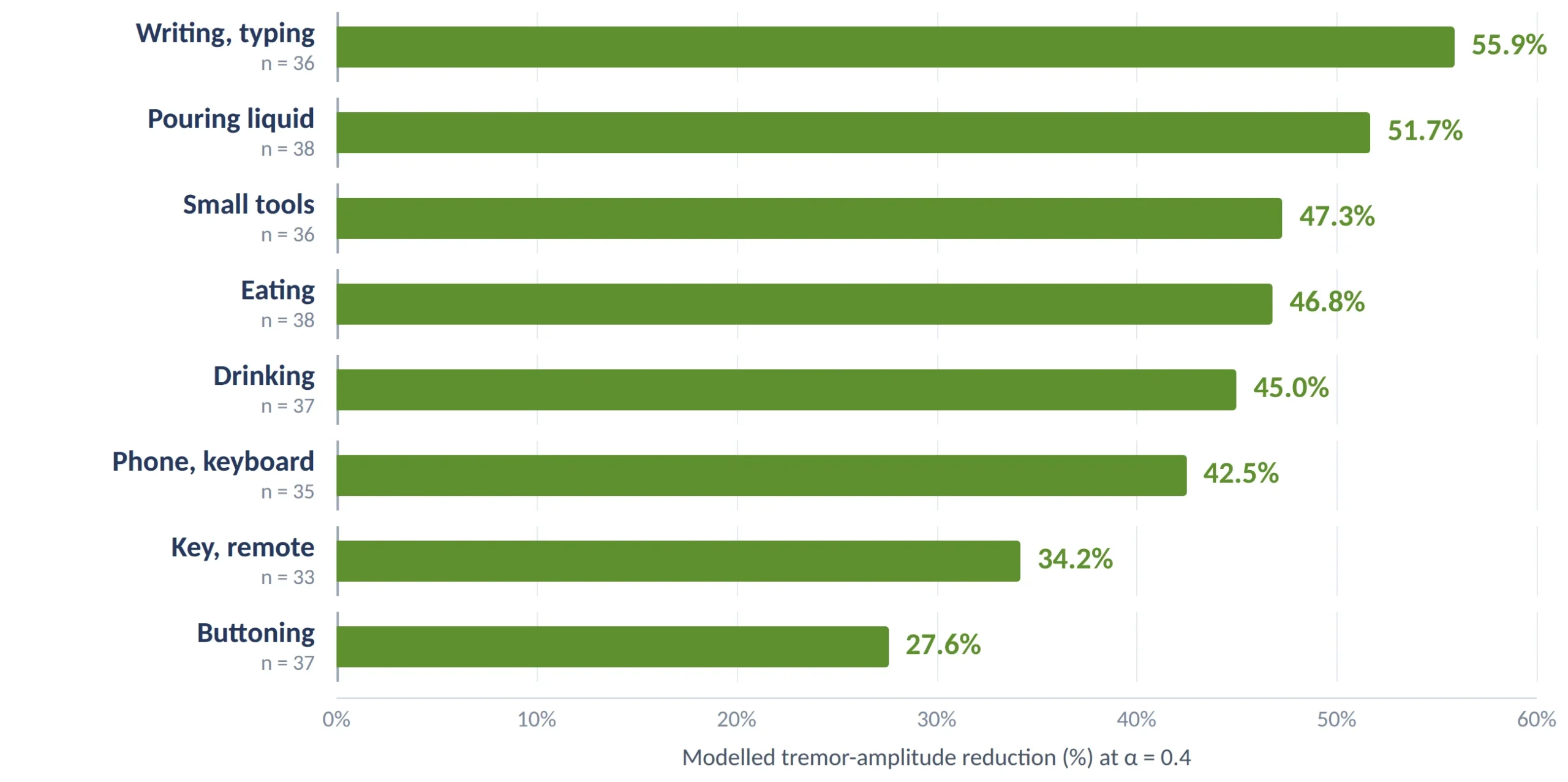
Post-market survey, 62 users
What users report in daily life
These are estimates converted from self-reported difficulty, not measured tremor, and the survey has no comparison group. In a survey of users, people who chose to keep the device reported an estimated average tremor reduction of 44%. People who returned it reported almost no change.3
2. Relative reduction in mean score versus no intervention, calculated from reported means.
Bench Testing
Independent study of the earlier Steadi-1
Safety
Limitations of this evidence
- No randomised controlled trial yet. The controlled studies are small crossover evaluations (9 and 20 people).2,5
- No head-to-head comparison with any other tremor device.
- The evidence is mostly in Essential Tremor. Parkinson’s Disease is represented by 5 survey respondents and no controlled data.3
- Three of the four datasets were designed, run or funded by Steadiwear.1
- The survey is self-reported and unblinded, and its amplitude figures are estimates.3
- About 2 in 10 participants did not improve compared with no device, and 3 in 10 compared with the placebo.2
- Durability beyond one year of wear is not yet characterised.1,10
The Cala Trio, a prescription device in the USA, has been tested in published randomised trials.11 No study has yet compared it directly with the Steadi-3 Plus, so the two can’t be ranked against each other.10
Evidence in progress
- A real-world outcomes manuscript is under revision at Tremor and Other Hyperkinetic Movements.3
- The full paper from the independent Steadi-1 study is pending.5
- A multi-hospital clinical study is under way in Turkey, covering Essential Tremor and Parkinson’s Disease.1
- A three-year post-market durability survey is planned.1
Patient selection
Is Steadi-3 Plus right for your patient?
Most likely to benefit
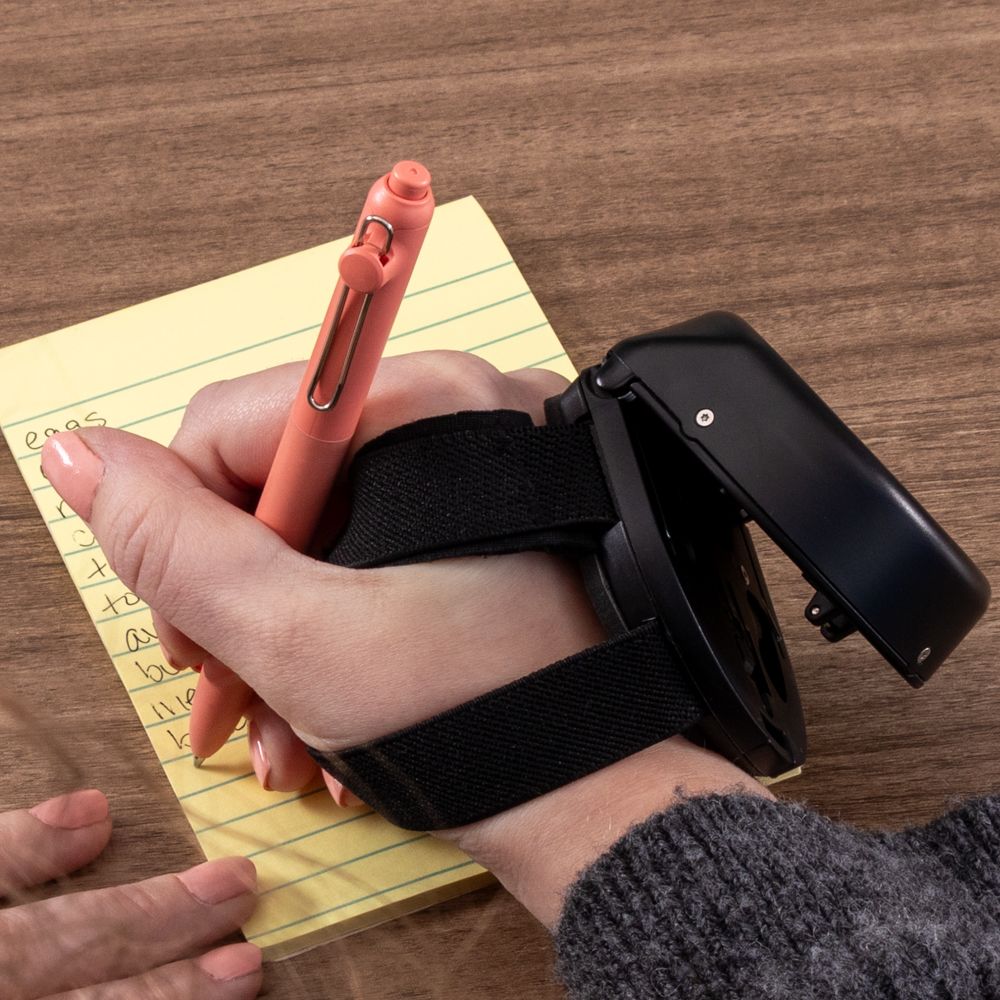
- Difficulty with cups, cutlery, pouring or signing
- Action or postural tremor of Essential Tremor or Parkinson’s
- Partial response to medication, or intolerance of it
- Patients who can’t predict when they’ll need a steady hand
- Declined surgery, or not a surgical candidate
- Both hands involved
Less likely to benefit
- Primary complaint is buttons, zips, keys or small screens
- Wrist pathology or proximal weakness: 300 g may not suit
- Tremor outside roughly 4 to 8 Hz10
- Patient won’t accept a visible device on the wrist
- Expecting the tremor to be eliminated rather than reduced
Response can vary with medication timing, sleep, stress and exercise.
Assessing a patient in clinic
Pick the task, then baseline it
-
- Ask which everyday task the patient finds hardest. Pouring a glass of water and signing a name are the highest-yield. Have them do it without the device while you watch.
Fit the device and repeat
-
- Fit it correctly: a loose or badly positioned unit underperforms. Repeat the same task within a minute. The effect is immediate.
Read the result
-
- A positive assessment is visible steadying within seconds. Little or no change on repeat means that patient is better served elsewhere, and you know it in the room.
At a glance
| Mechanism | Passive tuned mass damping with proprietary magnetic spring system |
| Power | None required – battery-free, no electronics |
| Weight | Approx. 300 g |
| Modes | Standard and Enhanced |
| Sizing | Small: hand circumference 22.9 cm or less · Large: over 22.9 cm |
| Configuration | Left hand, right hand, or pair |
| Materials | Silicone and neoprene foam strap; detachable stabiliser |
| Warranty | 12 months |
| Regulatory |
ARTG No. 531390
|
Testimonials
Real People. Real Stability.
Discover how Steadi-3 Plus helps users regain confidence and control in their daily lives.
Testimonials are from Steadiwear users and reflect individual experiences. Results may vary.
Resources
Clinical resources
Clinician product overview
Patient information leaflet
Instructions for Use
Fitting and demonstration video
Listen and learn
ReachMD NeuroFrontiers podcast
Dr Jerome Lisk speaks with Steadiwear’s co-founders about the engineering and early evidence.
Living with hand tremor?
Steadi-3 Plus is available to buy through Aurora Direct.
FAQs
Clinician FAQs
Is the Steadi-3 Plus clinically proven?
Why isn't the study published yet?
What is the sample size?
Can it be used alongside medication?
How do patients purchase Steadi-3 Plus?
Was the study funded by Steadiwear?
Sources
- Steadiwear Inc. Clinical Evidence Summary, STDW-CES-001 Rev 01, 13 October 2026.
- Steadiwear Inc. Blinded placebo-controlled performance evaluation of the Steadi-3. Internal report, February 2025. Available on request.
- Steadiwear Inc. Post-market activity-difficulty survey, N = 62. Manuscript under revision, Tremor and Other Hyperkinetic Movements.
- Steadiwear Inc. Six-degree-of-freedom bench validation report, November 2025. Available on request.
- Shi RB, Rizek P. Clinical and kinematic evaluation of a tremor-damping glove in essential tremor. Mov Disord. 2026;41(suppl 1).
- Fahn S, Tolosa E, Marín C. Clinical Rating Scale for Tremor. In: Jankovic J, Tolosa E, eds. Parkinson’s Disease and Movement Disorders. 1988:225–234.
- Lora-Millán JS, Hidalgo AF, Rocon E. A Review on Wearable Technologies for Tremor Suppression. Frontiers in Neurology. 2021.
- Mo J, Priefer R. Shaking Up Essential Tremor: Peripheral Devices and Mechanical Strategies to Reduce Tremor. Tremor and Other Hyperkinetic Movements. 2024.
- Therapeutic Goods Administration. Australian Register of Therapeutic Goods, ARTG entry 531390 (Steadi-3 Plus).
- Steadiwear Inc. Clinical evidence. steadiwear.com/pages/clinical-evidence (accessed 4 November 2026).
- Pahwa R, Dhall R, Ostrem J, et al. An Acute Randomized Controlled Trial of Noninvasive Peripheral Nerve Stimulation in Essential Tremor. Neuromodulation. 2019;22(5).